High school Art students are oft required to produce still life drawings or paintings within the confines of a busy classroom. Nigh Art Departments have cupboards crammed total of visually interesting objects that tin can be used to create still life arrangements. This article lists still life ideas for teachers or students who are stuck or in need of inspiration. The collection includes tried and truthful favourites that accept been used past Art teachers for generations, likewise as more unusual and contemporary still life topics.
What is a nonetheless life? Here is a definition provided by Wikipedia:
A work of fine art depicting mostly inanimate subject matter, typically commonplace objects which may be either natural or homo-made
While senior Art students are unremarkably free to come up up with their ain topic or theme (read our commodity how to come upwardly with keen subject matter for your Art project) many middle school or junior high schoolhouse students are required to work with objects and scenes that encounter the following criteria:
Viewable first-paw
Visually interesting, with a range of different textures, reflections, surfaces and forms
Small enough to fix and adapt in the classroom (calorie-free, easily moveable)
Able to bundled in different ways, creating original compositions so that multiple exciting works tin can be created
Durable plenty to exist handled safely past enthusiastic teenagers (without sharp or dangerous parts, for example)
Able to stored from lesson to lesson without eroding, decaying or breaking (this is non necessary if the however life can be fatigued within a unmarried lesson or photographed for completion at a afterward date)
Appropriate for younger students to view (i.e. non offensive)
This articles includes keen work by students as well every bit famous still life artists. It is a work in progress, with many more ideas to be added over time!
50+ All the same Life Drawing Ideas
Popcorn, as in these original even so life artworks by Po Yuan (left) and Betty Chen (right), students of Elizabeth Jendek, Thai Chinese International School, Samutprakarn, Thailand:
Although at that place is a distinct possibility that a number of still life items might mysteriously 'disappear' during the grade of this lesson, popcorn provides an excellent opportunity for practising the application of tone. Completed in charcoal, these large works create a kind of semi-bathetic landscapes and require careful attention to light and shadow.
Crumpled newspaper bags, such every bit this work past xviii year old artist Raegan Koepsel:
Crunched and creased paper bags create dramatic shadows and provide an splendid opportunity to acquire about tone. This is a great subject to depict with charcoal on mid-tone grey or brown newspaper. In this example, the paper bags have been twisted in different means and advisedly assorted with a background of corrugated cardboard.
Styrofoam cups, as inspired by this activity by the DC Sketchers:
This is an excellent cartoon action to help students understand how to represent ellipses (the oval shape that is visible when a circle is viewed from angle). The hollow truncated cones go surrounded past shadows and beautiful pockets of curving negative infinite, creating a superb still life drawing lesson. Photo courtesy East City Art.
For more than about drawing ellipses, please read 11 tips for improving your observational drawing.
Machinery and mechanical parts, such as old sewing machines, disassembled clocks, cogs/wheels and typewriters, inspired by this cartoon from Parkway Due north High School, United States, taught by Art teacher and creative person Grant Kniffen:
When the inner workings of mechanical items are exposed, there are often countless opportunities for art-making. In this observational drawing, the circuitous alphabetic character keys, crunched paper and detailed ink ribbon contrast the smooth surfaces of the typewriter and tabletop.
Many high school Art projects within New Zealand are based around the beach and coastline. Items such every bit rope, floats, hooks, anchors, driftwood and fishing nets provide an excellent field of study matter for still life works due to the variety of shapes, forms, patterns and surface textures. The items are usually large and substantial enough that a still life organization in the eye of the room tin can exist viewed easily by all students. These two works by American Popular artist, Roy Lichtenstein, 'Cape Cod Yet life' and 'Cape Cod Even so Life (Study)' show nets and rope entangled around an driftwood and shells. The bottom piece of work is an oil and Magna (a brand of acrylic resin pigment) completed in 1972, with a fatigued composition study above.
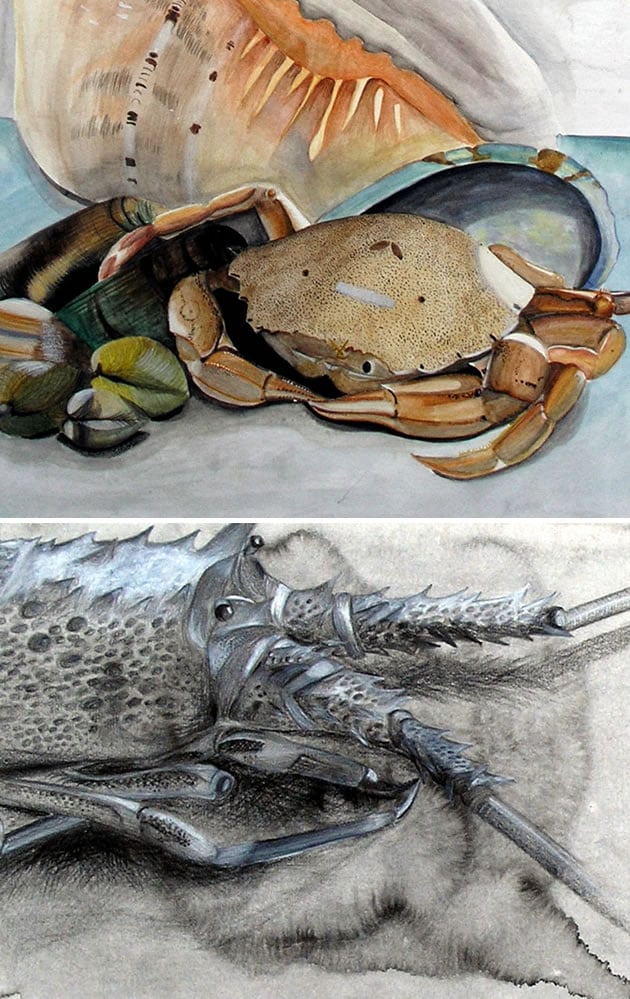
Fish, crustaceans and other seafood, such as these loftier school however life paintings from an IGCSE Art Exam by Nikau Hindin, ACG Parnell College:
Still life paintings of fish and other sea creatures can brand for an exciting lesson – especially when the real items are slapped onto the centre of tables in the Art room (it may be worth checking out where these tin exist stored in between class – staff rooms may have infinite in the freezer)!
Science equipment, inspired by this pencil still life from a student of Grant Kniffen at Parkway North High School, Us:
Drawing exercises such equally this tin can be a keen way for making connections between other subject areas inside the school. In this case, it might exist possible to mimic a scientific experiment that students are currently learning about. Annotation the stunning limerick in this work, with the combination of slightly curving textbook images and text providing an appropriate groundwork to the detailed iii-dimensional microscope.
Wooden mannequins, every bit in these black and white yet life drawings by Form 10 and Grade 11 students from Conway Loftier School, United States, taught by Carla Owen. Jeff (left), Dylan (eye) and Nathan (right):
Wooden mannequins can be great however life additions, posed equally if the figure is interacting / responding to its environment. In this still life cartoon lesson, varied line weight has been used to create depth and create focal areas within the work.
For more line cartoon examples, delight read our comprehensive Line Drawing Guide for Art Students.
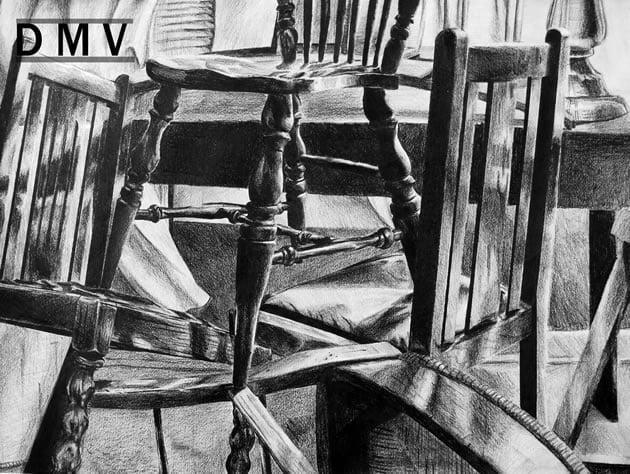
Armchairs, chairs or stools, equally in this example by Daniel E. Munoz-Vidal:
Art classes may merely have access to mundane stools. Sometimes, withal, an Fine art teacher will acquire an old chair, sofa or carved wooden chair that can go a permanent addition to nonetheless life collection. In this well composed cartoon, chairs and tables accept been positioned so that their forms intersect and piece up the page.
Dolls, train sets and other toys, such as this observational cartoon of a teddy acquit completed equally part of an AQA GCSE Art and Design project student by Holly Reynolds from Male monarch Edward VI Camp Loma School For Girls:
Still life paintings of toys are a popular pick amongst middle and high school Art students. Although there can be risks with drawing cartoon-like toys, or those with distorted proportions (it can be difficult for an examiner to tell whether the drawing is badly proportioned rather than the toy itself, for example) items such as one-time and broken dolls, ancient teddy bears and intricate railroad train sets make excellent still life material. This A3 cartoon past Holly was completed from kickoff-hand observation, in response to the topic 'Memories', using a range of graphite pencils (5H – 9B) and a putty eraser.
Bottles, vases, jugs and vessels (this topic was inspired past a Highcrest Academy Art Department Pinterest board), such as the famous Giorgio Morandi yet life drawings, etchings and paintings:
Giorgio Morandi, a famous notwithstanding life artist who died in 1964, is well known for his deceptively elementary still life artworks, which repeat many familiar household items, such as vases, bowls and bottles. Morandi positions these with careful precision, with each object treated as if it were a sculptural entity: a formal exploration of space and form. His paintings in detail have a subtle utilize of tone. The 1928 etching in a higher place, titled "Grande natura morta con la lampada a destra", may inspire students to produce pen drawings that accept a like cross-hatching aesthetic.
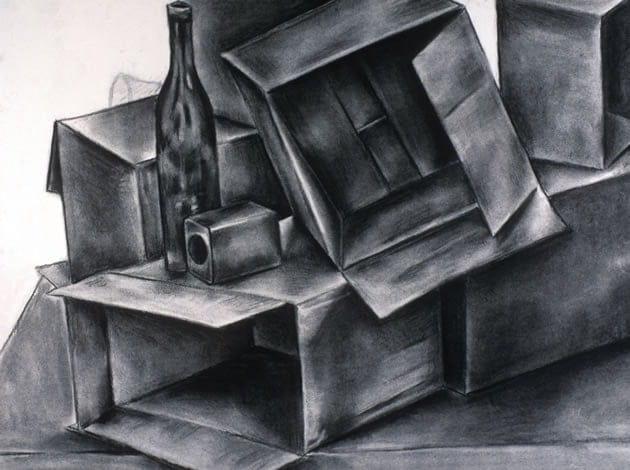
Empty boxes, inspired past a drawing exercise completed by a student of Nicole Havekost:
Boxes provide a great contemporary still life objects. At get-go glance boxes seem uncomplicated to describe; they are comprised of primarily straight lines, flat planes, with lilliputian detail; however, this task demands a practiced agreement of perspective and challenges students to really use their eyes to observe the variation in tone. Previously unnoticed details begin to jump into vision: creases, text, peeling edges of cellotape. This activity could be presented as a quick notwithstanding life gesture cartoon or a meticulous, detailed observation of angles, planes, light and form.
Jewellery and treasure boxes, every bit in these still life paintings by IGCSE Art and Blueprint pupil, Nikau Hindin, ACG Parnell Higher:
This work was produced within several cartoon lessons that asked students to produce still life paintings with night backgrounds (such as the necklace shown on black acrylic paint) and work over other prepared grounds (for example, the still life on the left is completed using Carandache crayon upon watered downward acrylic). The jewellery boxes provide students with the opportunity to represent three-dimensional infinite, while the jewellery itself adds glistening, detailed focal areas within the work.
Preserved animals and other specimens in jars, such as these modern however life artworks by Cindy Wright:
In add-on to insects, Scientific discipline Departments frequently take wonderful preserved animal specimens that make for great still life subjects. If these are unavailable, yous might wish to create your ain dramatic estimation, based on the yet life compositions above by Cindy Wright. These works force united states of america to run into the lifeless gaze of gutted fish coiled within a glass fish bowl.
Fruit and vegetables, inspired past Paul Cezanne's notwithstanding life with apples:
Fruit and vegetables are cheap enough that large quantities can be purchased for classroom use, assuasive students to organise the still life arrangements themselves or in minor groups. Dedicated students may bring more unusual items from dwelling house. Although a still life comprised of fresh food is unlikely to final longer than a week (less inside rambunctious classrooms) vegetables such every bit garlic, potatoes, onions, gourds and pumpkins tin can be kept for a much longer elapsing. In that location is besides the opportunity to include wooden tables and other even so life items in the groundwork. These famous still life paintings by Paul Cezanne are titled 'Rideau, Cruchon et Compotier' (which ways Curtain, Jug and Fruit Bowl) and 'The Basket of Apples' (the lower artwork). Both yet life paintings are completed using oil and canvas in the 1890s and judged past some to be among the best still life paintings ever.
Vintage cameras, as in these drove of observational drawings by Twelvemonth 9 student Dougal Burden from Takapuna Grammar School:
This exercise introduces students to different mediums and provides feel rendering a range of different reflective, smooth and faintly textured human being-made surfaces. It too provides corking style to spark other Visual Art interests and share cognition about early photographic techniques.
A glass of h2o, such as this example by Hanna Asfour:
Although it is most impossible for a high school form to get to the end of a water-based lesson without somebody spilling something, this do can be a stunning and challenging task that really helps conquer the fear of transparent surfaces head-on. With skilful lighting, this task allows students to render the drinking glass, h2o and the sparkling tonal variations inside the shadow. A task of this nature can exist a great one-lesson action, perhaps set as 'test' or ane-off assignment.
A jug and cup of tea, with inspiration from cubist still life paintings by Juan Gris:
Afterwards preparing the cartoon surface with a painted ground and glued downwards newspaper (some of which may take decorative patterns that mimic wood grain or a table material, for example), students may overlay fragments of observational drawings, from slightly distorted angles, with tone softly applied n the fashion of Juan Gris. This synthetic cubist piece was completed in 1914 using oil and mixed media and is titled 'Breakfast'.
To see other groundwork ideas, please read Painting on grounds: creative use of media for Painting students.
Hands, equally inspired by this observational drawing by Cath Riley:
Contemporary creative person Cath Riley has produced a series of detailed, highly realistic graphite pencil drawings of easily, including many in which the paw is touching, squeezing or gripping human flesh. Hands are an accessory that students are able to gear up and brainstorm cartoon immediately. Each can pose their hand in an original position and have this with them to depict from in whatsoever location. This makes hands an ideal bailiwick for quick still life sketches.
Marbles, spheres and balls, inspired past Pedro Campos paintings:
Well known gimmicky withal life creative person Pedro Campos creates hyper realistic nevertheless life paintings, such as the marble and golf game ball oil on canvas work, 'Military camp Creek', above. Drawing marbles and other spherical objects challenges students to focus all of their attending upon color, tone and surface; capturing glistening reflections and textural variations to enhance the illusion of reality.
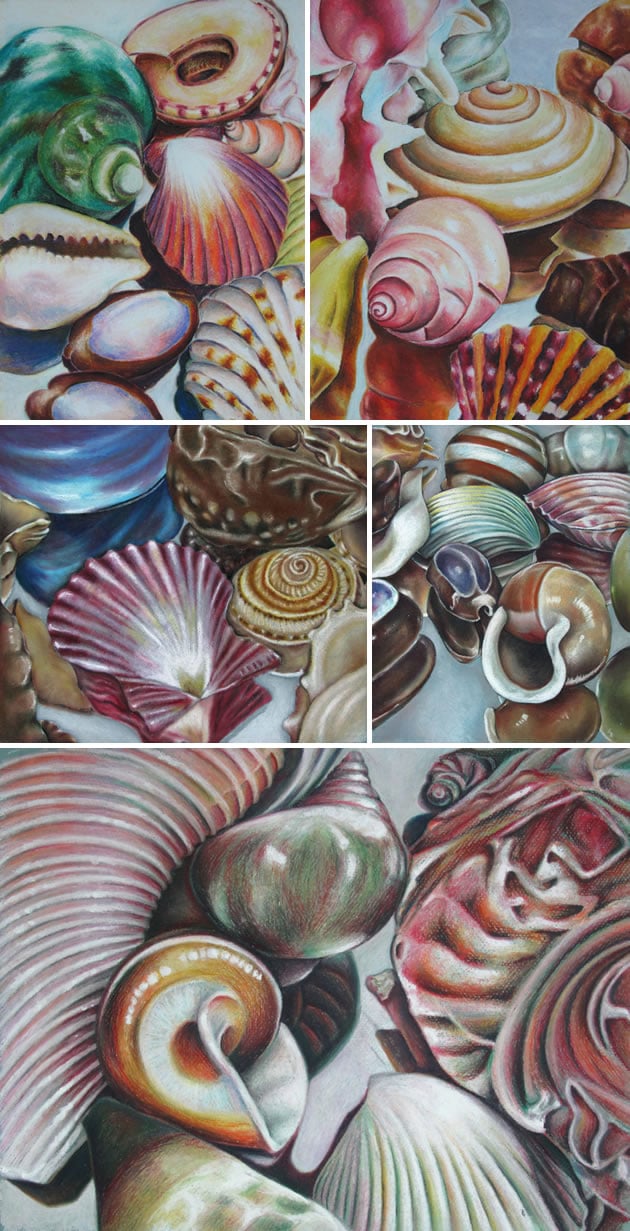
Shells, as in these artworks from the students of Elizabeth Jendek (from left to correct): Marisa Leong, Supanan Lee, Miri Morita, Warin (Pinky) Rungsakaolert and Po Yuan, completed while studying at Thai Chinese International School, Samutprakarn, Thailand:
In improver to provided a wealth of varied visually interesting forms, shells are durable plenty to survive the energy of a high school Art classroom. In this stunning unit of measurement of work, students accept produced vibrant, loftier dissimilarity oil pastel artworks. These works were completed later formally analysing the work of Georgia O'Keeffe, working outset-hand from withal life arrangements, mirrors to assist generate complex compositions.
Insects, such as these stippled pen drawings upon colored wash, completed by Grade 11 students Emery (left) and Caleb (right) from Conway High School, United States, under the direction of experienced Fine art instructor, Carla Owen:
Cartoon insects can exist challenging, due to difficulty sourcing first-manus imagery. It is sometimes possible to purchase dried and preserved insects in display cases and to use a magnifying glass to make the task of observing details easier (Science Departments oftentimes have a set of these). The striking examples higher up have been completed using black pen applied in dots (stippled) to a watercolor ground.
Potted plants, succulents and cacti, inspired by Laura Garcia Serventi's illustrations on Etsy:
With an appropriate selection of plants (ideally those that can survive long periods without attentive intendance) and interestingly shaped plant pots, this can form the basis of a keen still life painting lesson plan. These works by Laura Garcia Serventi include a diversity of contrasting found forms and flowers, with different subtle patterns, pots positioned on a dramatic tiled floor.
Metal taps, silverware and other highly reflective objects, every bit is illustrated in this video of how to depict a spoon past VamosART.
Many resource that demonstrate 'how to describe step-past-pace' encourage students to depict past formula, rather than learning to see and tape what is in forepart of them. This time lapse video is very helpful, even so, as information technology provides adept insight into how tone can exist built up using lite and dark pencils on mid-tone paper.
Origami or folded newspaper, inspired past this observational drawings by Sean Dooley, a graduate of Savannah Higher of Art and Design:
Folding paper can create stunning shadows and a mesh of intriguing angular lines. This example is one that is included in our list of substitute fine art lessons, and can involve students first constructing origami, earlier producing observational drawings in a range of different media.
Delight view our list of substitute Fine art lessons for more i-off drawing lessons.
Bones and skeletons, as in this example by Twelvemonth 11 student Manisha Mistry, from ACG Strathallan College (please view her full IGCSE Fine art and Design Coursework project):
Folding paper tin create stunning shadows and a mesh of intriguing angular lines. This example is one that is included in our list of substitute fine art lessons, and can involve students first amalgam origami, before producing observational drawings in a range of dissimilar media.
Complex interiors and window panes, as in this Henri Matisse nonetheless life:
Titled 'Still life after January Davidsz De Heem's 'La Desserte'' this painting is Matisse's interpretation of a piece of work by seventeenth-century Dutch painter Jan Davidsz de Heem. Drawing influences from cubism, Matisse contructs the scene using intersecting angular lines. In this exercise, the background may take on equal importance with the central withal life, with open up windows / table surfaces / surrounding items becoming a prominent part of the composition. This task may also become an 'inverted yet life', where the still life system is pushed into the foreground, with background items helping to fix the scene and tell a story.
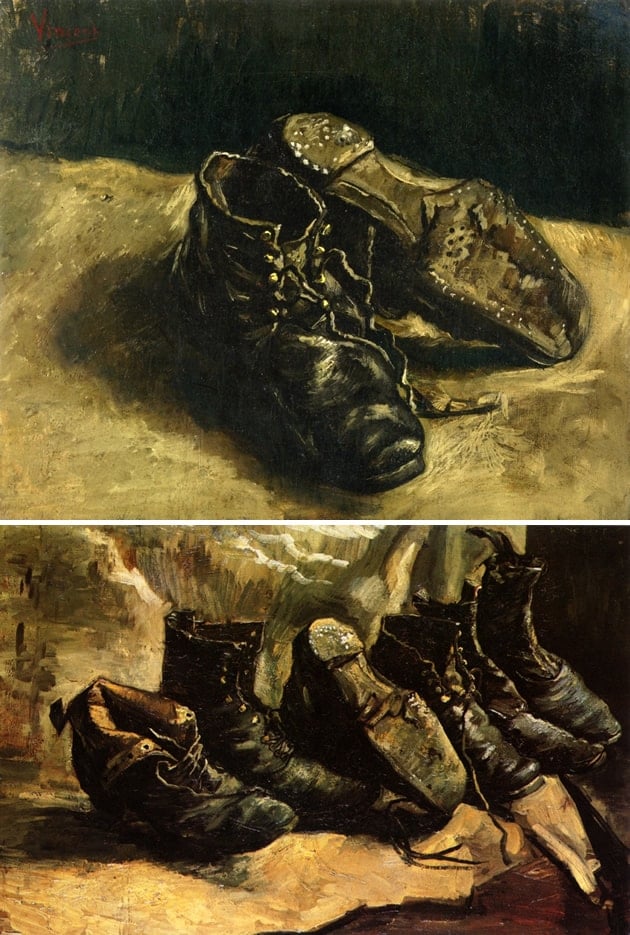
Old shoes and sandals, as in these examples by Vincent van Gogh:
The traditional 'however life with old shoe' remains a popular option among Art students. Shiny surfaces frequently contrast metal buckles, twisted laces and furled edges of leather. Shoe shine and brushes can also exist a not bad addition. These van Gogh yet life paintings were completed using oil on sheet in the 1880s and are titled 'A pair of shoes' (top) and 'Three pairs of shoes' (bottom).
Fine art-making equipment, such as is this instance by Textiles Art instructor Gayle Bicknell, which was prepared as part of a lesson for her BTEC art class at Alton College, Hampshire, UK:
This topic lends itself to Jim Dine inspired charcoal yet life drawings – working with a range of mixed media and textural backgrounds. This teaching example past Gayle is a graphite drawing of a single pair of scissors over a collaged background that has then been photographed and digitally manipulated.
Woodworking tools, as inspired by this didactics exercise by Jaime Brett Treadwell, artist and full-time Professor who teaches foundation courses for all AFA programs offered at Delaware Canton Customs College including Studio Arts, Graphic Pattern, and Photography:
In this chore, students are encouraged to set tools upon a canvas of white paper, with a light source (such every bit an inexpensive table lamp) shining upon from an angle that creates interesting shadows. Students use a viewfinder to select a limerick from the arrangement, because the relationship between positive and negative spaces. The image is created using a range of experimental techniques, such as erasing back areas, rubbing the paper with napkins and so on. Visually pleasing tools that are scarred and dilapidated with use can oftentimes be sourced at depression price from 2nd hand shops (call up information technology is all-time to avoid those that may cause inadvertent injury). Every bit with above, woodworking tools are a bang-up subject thing to use while studying the work of Jim Dine.
There are as well great ideas for tools in this dandy Highcrest Art Department Pinterest board.
Weaving, as in this example by Year eleven IGCSE Fine art pupil Manisha Mistry, from ACG Strathallan College:
In this still life lesson students were required to research traditional flax weaving methods and make their ain experimental weaving. They then created observational drawings from these and photocopied the weaving for subsequent tasks. Weaving drawings offer the opportunity for students to exercise blending colors in a wide range of unlike mediums.
Musical instruments, as in this detail from a Pieter Claesz vanitas yet life:
High schoolhouse Music Departments are sometimes willing to lend instruments that can exist used in nevertheless life displays; with instruments overlapping in order to create interesting shadows, as in the particular of the oil painting higher up by Pieter Claesz. This work is titled 'Vanitas Still Life with the Spinario' and was painted in 1628.
Y'all may likewise be interested in viewing this 100% AS Coursework project based upon an abstraction of instrument still life by Year 12 As Art and Pattern pupil Nikau Hindin, ACG Parnell Higher.
Former books, such equally this example of a Dutch still life with books completed in 1628 (artist unknown):
Beautiful old books can often be purchased from second-hand shops. School English language, Geography, Science and History Departments too may accept great onetime textbooks that have been discarded by past students or are no longer used. Many of these may have pupil graphite, dates or other notation in them that can provide welcome variety and visual interest in even so life drawings and paintings of books.
String, sticks and stones, inspired by a instruction exercise designed by Andrew Strachan (at present teaching at ACG Senior Higher).
In this activity, students are presented with a drove of sticks, string and stones, and asked to create a sculpture by tying together the sticks and hanging a rock from this using the string. Observational drawings are so created of this, with the tension of the thin, taut string contrasting the textured wood and stone.
Yet life with flowers, inspired by these Vincent van Gogh sunflowers:
A drawing of flowers can become cliché, 'pretty' or uninspiring (adding to the countless formulaic roses, hibiscus or lily flower drawings that make full the world). Extreme care should be taken to guide students away from 'rote' or 'formulaic' drawing, where the flower is drawn from memory or step-past-footstep according to some predetermined blueprint, without outset-hand ascertainment of form or tone. You lot might choose uncommon flowers, or those that are damaged, stale or decayed, for instance. Rather than in a flower pot or vase, the flowers might be scattered upon the basis, as in '4 cut sunflowers' by van Gogh above. It is as well worth noting that blossom still life drawings and paintings can as well be a striking with family members, with many parents enthusiastically displaying blossom drawings (much more than so that with some of the other however life suggestions on this page)!
Lamps, lanterns and low-cal bulbs, as in this charcoal drawing by Akrawczyk:
In addition to transparency and curving reflective surfaces, these even so life objects often have thin wires and/or power cords – and often emit light themselves – making them an extra challenging and exciting object to draw.
Collections of pop contemporary foodstuffs – bright packages and eye communicable labels – can be used to create stunning compositions, as in this Tom Wesselmann notwithstanding life. Many of these 'pop objects' have the benefit that they are packaged and long-lasting, able to exist stored for some time in an Art room cupboard.
A cluttered desk-bound, inspired by this Jean-Baptiste-Siméon Chardin notwithstanding life:
Although Art students are often masters of the cluttered desk syndrome, this task can be set up inside a classroom with more purpose, and then that the selected objects are part of a narrative, whereby the composition conveys a item backstory and meaning. In this Chardin still life, titled 'The Attributes of the Arts and the Rewards Which Are Accorded Them', completed using oil on canvass, objects have been selected to represent various artistic disciplines – painting, drawing, compages and sculpture – and are arranged aslope a ribbon with a cross, the highest honour an creative person in this region and time could apparently receive. The work was completed using oil on canvas in 1766.
A decorated pinboard, as in this still life painting by Jean-François de Le Motte:
Still life arrangements can exist hands pinned to classroom pinboards. This painting, completed in 1670, includes a painting inside a painting, a letter to the artist, a printed pamphlet and an bookkeeping booklet.
Eggs, equally in this AP Studio Art summer assignment fix by teacher Billy Hicks:
Students throughout the ages have voiced their frustration when they are set the job of applying tone to drawings of eggs, nevertheless near all encounter the value of the exercise when the work is complete. This still life activeness involves a contrast of textures, with the smoothen eggs resting on textured cloth or crumpled paper towel to create a visually pleasing composition. Another variation involves drawing open up egg shells, with light falling across the concave and convex surfaces.
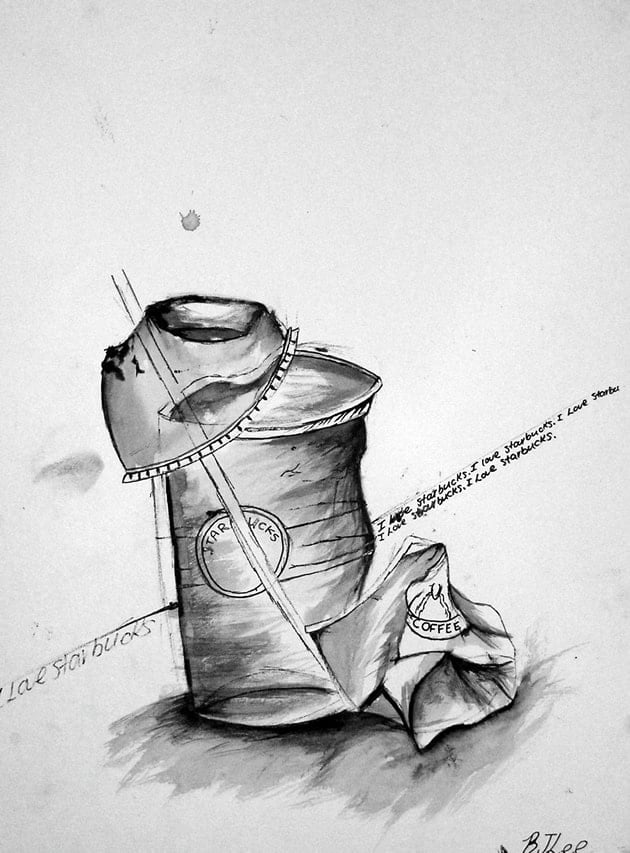
Rubbish / litter / discarded remains, as in this drawing by Brittany Lee, Year 10 Art pupil at ACG Parnell College:
Samples of litter and other remains, such as orange peelings, assistant skins and apple cores can brand fantabulous still life subjects. This piece of work was completed using black Indian and h2o on wet-strength cartridge newspaper. Information technology was completed within ane hour.
This drawing lesson also featured in our list of ideas for substitute Art teachers.
Seedpods, as inspired by this observational drawing by IGCSE Art and Blueprint educatee, Claire Mitchell, ACG Strathallan College (yous may besides like to view this Highcrest University Art Pinterest board for inspiration):
Seedpods come in many intriguing organic shapes and forms. They typically terminal for a long time and are readily available – ofttimes in the schoolhouse yard itself.
Shirts, dresses and drapery, as in these examples by the students of Kristy Patterson, Guymon High School:
Shirts, dresses and other clothing items, which might include coat hangers, zips, buttons, belts, buckles, items of adornment, as well equally traditional costumes, offering the opportunity to describe draped folded cloth alongside more complex accessories, pleats, seams and fabric details. In the do above, students produce realistic drawings of a personal item of clothing that are pinned to a brandish console (the panel tin can be shifted aside and placed in storage until the side by side class).
Random objects hanging from cord, as in these graphite drawings by the students of Jaime Brett Treadwell, creative person and full-time Professor who teaches foundation courses for all AFA programs offered at Delaware Canton Community Higher including Studio Arts, Graphic Design, and Photography:
A yet life composition that is created from hanging objects has the presence of the string to create tension and linear elements, alongside unexpected shadows, angles and alignment of objects. It tin can besides outcome in dramatic contemporary imagery, as students hang and explore unusual subject matter.
You lot may also wish to view this high school fine art project by Nikau Hindin, which contains images derived from decaying fruit and vegetables hanging on cord.
Cutlery and kitchen utensils, equally in this warm-up drawing exercise by the students of artist and teacher Julie Douglas:
This do is one of the near challenging on this list. The yet life drawing combines reflective surface, convex and concave forms with minor details and knotted string.
This work was earlier featured in How to Create an excellent Observational Drawing: 11 Tips for High School Art Students.
Did you lot enjoy this list? Delight share it with other Fine art teachers and students that you know!
Amiria has been an Art & Design teacher and a Curriculum Co-ordinator for seven years, responsible for the course design and assessment of student piece of work in ii high-achieving Auckland schools. She has a Bachelor of Architectural Studies, Bachelor of Compages (First Class Honours) and a Graduate Diploma of Teaching. Amiria is a CIE Accredited Fine art & Design Coursework Assessor.














0 Response to "Ideas for What to Draw for an Art Project"
Post a Comment